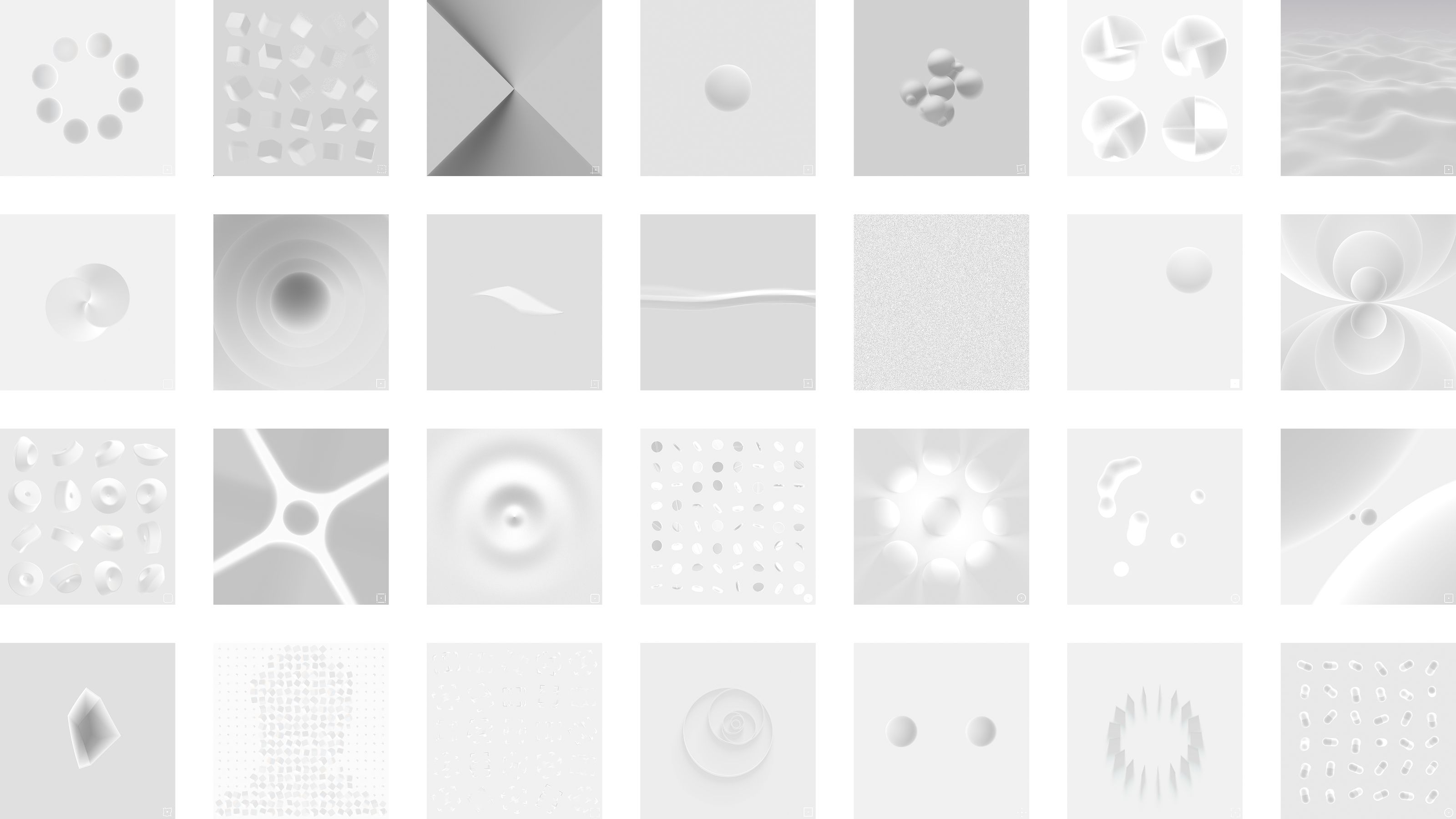
Art should outlive its creator. A painting doesn't need permission to exist. A sculpture doesn't rely on a server staying online. Paradoxically, digital art is more vulnerable than physical art. The image lives on a server. Ownership depends on a marketplace.
Could digital art be truly autonomous and immutable? A single artifact that contains everything it needs. No server to shut down or marketplace to delist you. Does a piece need to exist in the physical world at all? What does ownership mean when the object is code? Who really owns what you collect? Can a piece of code run by itself, exist on its own terms on a world computer, and make the interaction between artist, art, and collector direct? These are the questions Han keeps asking. The work is an invitation to ask them with you.
Art = Smart Contract = Marketplace
The visual system, ownership record, and marketplace are unified in a single artifact smaller than 24 kilobytes. The artwork runs on code stored permanently on Ethereum, tracking its owner and enabling its sale. A piece acquired today will exist and operate for as long as Ethereum runs, outliving its creator. The relationship between collector and artwork is direct and permanent.
Try clicking ↓
The Core
The art is built using shaders, small programs that run on your device's graphics chip (GPU), calculating the color of every pixel in real time. Think of it like a recipe instead of a photograph. A photograph captures one moment. A recipe can create infinite variations. The shader is the recipe: a set of instructions that takes time and screen position as inputs and produces color as output.
Each contract contains minified JavaScript (~15KB), buy/sell/bid functions (~8KB), and events (~1KB). Royalties can optionally be enforced at the protocol level during contract creation. This approach is ideal for permanent onchain art: tiny file size, complex visuals from minimal code, resolution-independent rendering, and complete self-containment, unlike traditional digital art with its three points of dependency: server, token, marketplace.
Contract Addresses
Every contract is verified on Etherscan. The complete code, ownership history, and transaction records are public. The source code, including the visual system, is embedded and auditable. What you see onchain is what exists.
FAQ
What is Ethereum?
Ethereum is often called the "World Computer," a global trustless network of hundreds of thousands of computers running together as one. Unlike a regular server that one company owns and operates, Ethereum is maintained by participants all over the world.
What is a smart contract?
A smart contract is a program that lives on Ethereum and follows mathematical rules set when it was created. Think of it like a vending machine: put in the right amount, press the button, get your item. It works 24/7 by itself with no one running it.
What is onchain art?
Most digital art, even NFTs, stores the actual image on a server or cloud service. You own a token that points to the art, but the art itself lives somewhere else. If that server shuts down or the company disappears, your art could vanish while you still hold the token. Onchain art is different. The actual code that creates the visuals is stored on Ethereum itself.
Are those NFTs?
Not exactly. Standard tokens point to art stored elsewhere and rely on external platforms to trade. Each 1 of 1 is different: a self-contained smart contract where art, ownership, and marketplace are unified. Buy, sell, and bid directly through the contract without a middleman.
Where can I buy or sell?
A dedicated UI is available at art.han.io. Every contract is also verified on Etherscan for those who prefer going direct. The process looks like buying or selling any other non-fungible token. The difference is underneath: you interact with the art piece itself, not a marketplace contract.
What do I actually own?
You own the smart contract itself. When you acquire it, ownership of the entire contract transfers to you. With standard tokens, the contract remains under the creator's control. Thousands of tokens can exist under one contract owned by someone else.
Can the art be modified or deleted?
No. Once deployed, the code is permanent. No one can alter or delete it. Not the owner, not the creator. The piece exists exactly as written for as long as Ethereum runs.
How do I view the art?
Visit art.han.io to view all pieces in your browser. Each artwork renders in real time on your device. For direct access, every contract has an artpiece() function that returns the complete HTML. Call it from Etherscan, save the output to your device, and open it in any browser.
Will there be more pieces?
Yes. Han uses this format for his 1 of 1 works. There is no specific timeline.